Monday, June 4, 2018


Using a Samovar to Think about Edna

At last week’s LAJSA NYC 2018 (a bienniel regional conference of the Latin American Jewish Studies Association http://www.lajsa.org/fifth-regional-research-conference-2018/ ) we concluded two exciting days exploring Jews and Race in Latin America with an intimate memorial to our colleague, our friend, our teacher and mentor Edna Aizenbeg who passed away recently. Her husband and spiritual partner Yehoshua came and talked about Edna, her path towards a life of scholarship, her courage to push through intellectual boundaries and overcome obstacles. He shared great stories of a day they spent with Borges in Manhattan, taking him out to lunch and watching him gleefully eat Borscht. 
Many of her close colleagues and friends sent personal reflections and several of the participants in the conference spoke movingly of her kindness toward them, of how she would push them to write better and to think better, of her toughness and sharp eye.

I would often run into Edna and Yehoshua in New York, often I was with my kids at some cultural event. The last time was on Christmas; we met like good Jews meet on Christmass, at the the Jewish museum. She recommended the Modigliani exhibit and said she wanted to talk about an idea for a panel on Race and Colonialism for the upcoming conference. And a few months later she was no longer with us. 
We decided to read a few excerpts from Edna’s writings- we chose a short but innovative and provocative piece from 1999, “How a Samovar helped me Theorize Latin American Jewish Literature”
Prooftexts May 1999

I shared the following short reflection before reading some of the most salient parts of that very tightly conceived essay.

.  .  .
This essay is one of the first things I read by Edna, I stumbled upon it as a young grad student.  – I was studying at NYU’s dept. of Spanish and Portuguese, and although I felt welcome by my colleagues and professors, my personal religious orientation, my time spent in Israel and my lack of formal training in a classical program in Spanish lit. set me apart – at least in my own mind.

Stumbling on this essay was anchoring and energizing:
the center needs the periphery,
 the canonical can be read best, sometimes, by reading otherwise
And where is the center anyways?

These were all questions and sensibilities expressed in many of my graduate seminars, especially the most exciting ones – but Edna helped me think about these ways of reading in light of Jewish culture.

Do the jarchas belong to Spanish literature or Hebrew- are they the provenance of a Jewish studies department or a Spanish dept. – Thankfully they belong to no one; they invite multiple, polyvocal readings

Latin American Jewish Studies can speak across disciplines, it is both inside and out, and it can be a place that embraces the multi-lingual and the rich, fractured legacies that are the inheritance of a Jewish author.

Edna was a great translator of text and ideas into English. She made the particulars of a story, the nuances of a community in its historical moment come across clearly and evocatively.

I have the great honor at Yeshiva to teach a course on Jews in Latin America – almost all of my students are curious gringuitos- with nary a word of Spanish or Portuguese. I look at the syllabus and realize that I assign a lot of Edna.  I use so much of Edna’s work because it is such an eloquent interrogator of the classics—Gerchunoff and Borges- but also lesser known figures like the debauched poet of the seaside Venezuelan town of Coro- David Elias Curiel- linking (but not conflating) different eras and voices.

She also never forgot that literature is written in real time, for real people, the political and the social are never elided by literature, they pulse through the veins of even the most fantastical literary works.
“Books” AND “Bombs in Buenos Aires”! Both are real, both inform each other.


Monday, May 7, 2018

Quiero a todos los Gringos: Or how a Mexican dressed the stars of country music (and Ronald and Nancy Reagan) like Mexican vaquero divas


A block from my hotel in Nashville was a small corner boutique with a simple but oh so stylish sign in the window: Manuel. Manolo/Manuel was my dear uncle’s name, it’s a name that I love intuitively. So the name got my attention but then I looked inside and was amazed by the colors, the stitching, the curves and whirls of the jackets, and blouses and dresses in the window. The rhinestones and piping and stitched flowers fluttering on the lapels tailor-made for the stars, living, dead and striving of country music. 
I first saw the window when I went out for a quick run in the morning, the store was not yet open and I hoped to return later before the store would close- not sure of what I would find inside.

I made it a few minutes before closing, I walked inside and was greeted warmly by a young man, long blond hair, nose ring, urban-cowboy mustache. At first I just wanted to wander and then we got to talking. He brought me to the back room were all of the duds are hand sewn. I met two of the craftsman, one a young Nashville local and the other an older man from Michoacán (if I remember correctly). I found out that Manuel, the designer behind this store was also from Mexico. He began designing clothes in Los Angeles and then moved to Nashville for the more relaxed southern rhythm and in order to be even closer to the celebrities he would dress. I loved reading the framed letter from Ronald and Nancy Reagan thanking him for the ranch wear that they enjoy while on the Reagan ranch. 

It was next to a picture of Loretta Lynn in a white rhinestone Jacket receiving a presidential medal from Obama.  

Walking around this little shop I got to thinking about that most stereo-typically American style of music- country and western- and relishing in the irony that its stars knowingly or not were strutting onto the stage of the Grand Ole Opry and a 1,000 other stages wearing reimagined ranchero outfits, dreams of mariachis remade across the border.
The clothes are dazzling, kitchy and so much fun! There is grace and energy in the matching his and her suits and in the jackets of many colors and “nudy suits”. If I had more courage, or panache or money perhaps I would buy one of those suits- just for the thrill of it. I was tempted to buy a party of a t-shirt that was closer to my budget: rhinestone stars and stripes as backdrop Manuel declares: Amo a todos los Gringos! I love all of the Gringos. Times like these we could all use more Manuel!

I want to thank Julia Phillips Cohen and the Jewish Studies department at Vanderbilt University for hosting me in Nashville and gave me a chance to explore this fantastic city. It was wonderful to encounter passionate students and scholars interested in speaking across disciplines about big ideas in such a warm and welcoming setting. Perhaps some of the discussion of blood, race and faith in the first global age that afternoon informed this brief meditation.


Wednesday, April 25, 2018

Palimpsest: layers of history, memory, culture


A morning at the Kehila Kedosha Janina

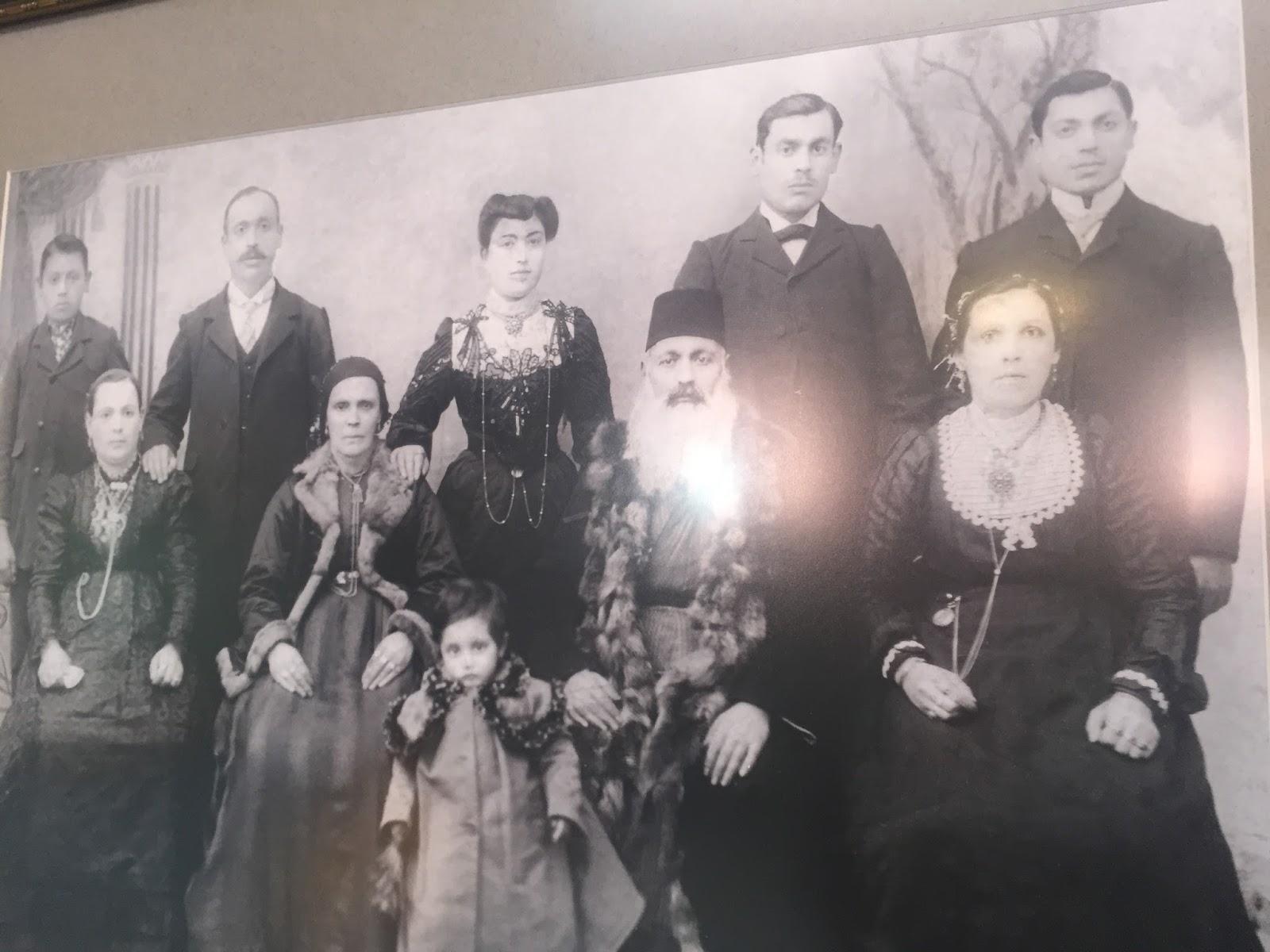
This morning I took a group of my students from Stern College and Revel Graduate school to one of the few remaining shuls on the Lower East Side, Kehila Kedosha Janina. Among the 400 places of Jewish worship that could be found in the tenements of the Lower East Side in the first half of the 20th century, Janina was unique. It was the spiritual home for the small yet ancient Romaniote Jews who found their way to the Americas. These Greek-speaking Jews have roots in the Eastern Mediterranean dating back to Hellenistic times. They maintained their customs and prayer rites throughout the major shifts of Jewish history. With the arrival of the Sephardim after the expulsion from Spain this group was largely absorbed into the more numerous and culturally hegemonic new comers. Most of the Greek speaking Jews married into and merged into the wider Iberian Jewish society that was transplanted and transformed in the Ottoman Empire. However, throughout the Eastern Mediterranean there were those who maintained their distinct identity and kept this unique culture alive.


Our gracious, passionate and knowledgeable guide Marcia Hadad Ikonomopulus is a testament to the ways this community was at once distinct and deeply enmeshed in the wider Sephardic culture of the Balkans and Turkey- on one side she comes from Ladino speaking Sephardim and on the other she is Romaniote. She shared powerful stories of her family’s immigration and their efforts to keep their culture alive. 
 

I hope this visit can help my students think about their own family histories of immigration and the ways that each individual navigated their reinvention in the New World. I would like them to think about how their parents, grand parents or great grandparents figured out how much to keep and how much to forget or transform and adapt to their new home. Seeing how this minority within a minority within a minority managed to survive and thrive I believe can push us to rethink our own family narratives and better appreciate the layers of memory that we use to make sense of our place in history. 


For more information check out their website: https://www.kkjsm.org/

and don't miss the upcoming festival:
https://www.kkjsm.org/greek-jewish-festival


Wednesday, February 28, 2018

Queens, mystics, merchants and freaks: a Purim post


Erev erev Purim,
And its all about queens and ladies and women in the margins and at the center
And women again, and slaves, and the little guy, the criminals, the freaks and dreamers, and the great rabbis and poets too, reorienting periphery and center, all happening at Stern College

In my Inquisition course we read a tightly conceived essay by Emily Colbert Cairns about the figure of Esther among the conversos; with my course on Jewish Travelers we read about women in the Geniza through the letters between women and their husbands, sons, brothers, business partners and rabbis. I did not plan to have these two gender-heavy classes on the same date but I enjoyed the synergy between both classes and I hope to tap some of that energy in this brief post.

Lope de Vega, the most prolific, popular and accomplished dramatist of the Spanish Golden Age put on a play inspired by the story of the Biblical Esther in Madrid in 1610, La hermosa Ester. Emily Colbert Cairns led us through the transformation of the Jewish heroine from a quiet, obedient and objectified woman, conforming to the ideals of femininity put forth by the great ethicists of the day- Luis Vives and Luis de León (yes they are both well known conversos! But what of it?) – into a heroine who courageously upturns the social order, dares to speak up, reveals her Judaism and saves her people.

The basic Christological reading of the Book of Esther sees the Hebrew queen as a victorious Mary crushing the temptation of the satanic Haman. See the resplendent Virgin Mother crushing the serpent underfoot in this panting by Tiepolo:


Or in this not too subtle detail from a fleshy statue:

Surely much of Lope’s audience saw that standard narrative unfold in his play, but could they have missed the dangerous identity games at the heart of the story, the need for secrecy and the subversive assertion of Jewish identity at a moment where Spain’s Jews have been long converted or expelled, where just a year earlier the Moriscos were expelled from Aragón and Valencia, where blood purity statutes were still the norm? Lope de Vega himself was a “familiar” of the Inquisition, a lay spy in service of the Holy Office. In general it is hard to describe Lope as a radical playwright and yet his art in this instance gives voice to a polyvocal celebration of the many Spains- the deeply Catholic, the Triumphant Global Empire as well as the multi-cultural substratum that pulses under everything from flamenco guitar to paella.


The essay counterposes the Canonical Ester as reworked in its early modern Spanish cast with the Esther of the Marranos, the underground Esther, specifically with her image and allure within the intense religiosity of Isabel de Carvajal as recorded in her Inquisitorial trial. Colbert weaves diverse practices together to show how Isabel and her wider circle of conversa women in Mexico used the model of Esther, the pious, prayerful and heroic woman in their own secret religious life.[3]

A student commented that she was happy to be reminded of the centrality of Esther as the heroine of the story because for her the holiday is so male-focused? I foolishly responded with surprise- how is Purim a man’s holiday? After all woman are obligated in the mitzvoth of the day- “Af Hem Hayu be Oto Ha Nes”! “In my house my father and my brothers exchange divrei torah and drink at the table while the women serve them” I am still shaken by this image which should not surprise me.  I hope Isabel de Carvajal and Vega’s La Hermosa Ester can offer an alternative path to an empowered and energizing Purim!

In my course on Jewish travellers we read a variety of sources such as the rather fantastical text of Eldad HaDani, the short, dark skinned member of the tribe of Dan who wends his way to Tunis in the 9th century and regaled his fellow Israelites with tales of his fierce and free fellow tribesmen living beyond the Sambatyon river to the more fact heavy account of  Benjamin of Tudela who described his journey from Northern Spain to the Middle East. We also took some generic detours. We spent two wonderful classes on Yehuda HaLevi’s poems about his dreams of pilgrimage and his actual journey to the land of Israel. Yesterday we used Joel Kraemer’s engaging and comprehensive essay “Women Speak for themselves”” to rescue the voices of travellers and those they left behind as traced in the letters of the Cairo Geniza. It is hard to really appreciate the intellectual, psychic and cultural loss Jewish Mediterranean society incurred by deciding to not educate their daughters. For the most part Jewish women were illiterate while most men were not. (I pointed out that the situation was not the same in Ashkenaz where women worked along side their husbands and had to keep business records and thus could read and write. This also carried over to a concern for religious literacy.)The letters we have from women and to women were always mediated by a scribe and a reader- they could dictate and be read to and thus it is a small miracle to find expressions of intimacy in these exchanges between husbands and wives. A merchant far from home writes his wife: “the most difficult thing for me is every Friday night when I light the candle and put it on whatever table God provides, then think of you. God only knows what comes over me”

The texts are brimming with psychological and social details that bring the day to day life of the past into relief: mothers complaining about their sons' neglect –“you never write”, women seeking the aid of great rabbis to protect them from deadbeat or abusive husbands; passive-aggressive litanies of sacrifices made for the other, the challenges of medieval travel- pirates, storms, bad food, boredom.

I asked the students why I would have chosen this collection of texts for a class on travel? A sharp-witted student in the back quipped- “So we don’t feel left out?” It got a laugh and it opened up a good discussion. I was asking about how these letters fit into the genre of travel literature but she picked up on the more overt reality of a class of bright women reading about their past and not hearing of a single woman until today.

We talked about the treasure that is the Geniza and the way it allows us to find out about the everyday lives of so many of the people of the past that we would never have the faintest trace of without this bizarre and miraculous collection.

The Geniza gives us access to the details of the lives of the little people- not only the “Great Men” of history- the scholars, the leaders, the heroic scoundrels and false messiahs. We see what type of business contracts people made, their shopping lists and account books, and of course their letters! We can even capture some of their unadorned, colloquial voices as recorded without the artifice of refined pens. The study of women’s history is not just about women, just like the study of Jewish history is not just about Jews; whenever we engage the periphery, the center comes into better focus, all things are interconnected. I did not choose Kraemer’s article because I was teaching at Stern; I chose it because I want us to get as much of the picture as we can and I think the best way to do that is to enrich and complicate and decenter our narratives. In this dynamic reordering we can rethink our assumptions and see more clearly.
And on that note, Purim Alegre! May we tap into the sea of clarity and confusion that is this carnival we call life.