Wednesday, April 25, 2018

Palimpsest: layers of history, memory, culture


A morning at the Kehila Kedosha Janina

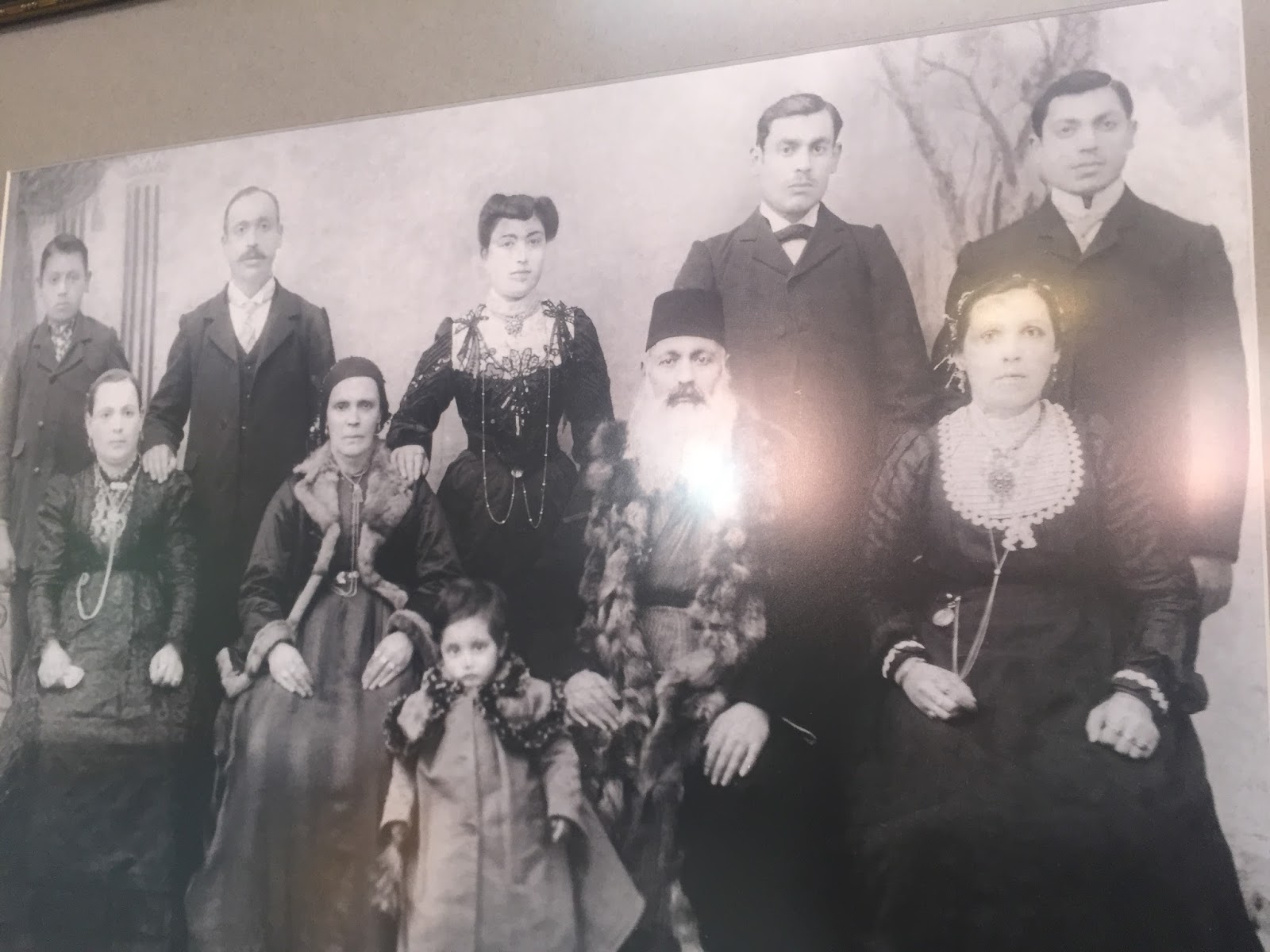
This morning I took a group of my students from Stern College and Revel Graduate school to one of the few remaining shuls on the Lower East Side, Kehila Kedosha Janina. Among the 400 places of Jewish worship that could be found in the tenements of the Lower East Side in the first half of the 20th century, Janina was unique. It was the spiritual home for the small yet ancient Romaniote Jews who found their way to the Americas. These Greek-speaking Jews have roots in the Eastern Mediterranean dating back to Hellenistic times. They maintained their customs and prayer rites throughout the major shifts of Jewish history. With the arrival of the Sephardim after the expulsion from Spain this group was largely absorbed into the more numerous and culturally hegemonic new comers. Most of the Greek speaking Jews married into and merged into the wider Iberian Jewish society that was transplanted and transformed in the Ottoman Empire. However, throughout the Eastern Mediterranean there were those who maintained their distinct identity and kept this unique culture alive.


Our gracious, passionate and knowledgeable guide Marcia Hadad Ikonomopulus is a testament to the ways this community was at once distinct and deeply enmeshed in the wider Sephardic culture of the Balkans and Turkey- on one side she comes from Ladino speaking Sephardim and on the other she is Romaniote. She shared powerful stories of her family’s immigration and their efforts to keep their culture alive. 
 

I hope this visit can help my students think about their own family histories of immigration and the ways that each individual navigated their reinvention in the New World. I would like them to think about how their parents, grand parents or great grandparents figured out how much to keep and how much to forget or transform and adapt to their new home. Seeing how this minority within a minority within a minority managed to survive and thrive I believe can push us to rethink our own family narratives and better appreciate the layers of memory that we use to make sense of our place in history. 


For more information check out their website: https://www.kkjsm.org/

and don't miss the upcoming festival:
https://www.kkjsm.org/greek-jewish-festival


Wednesday, February 28, 2018

Queens, mystics, merchants and freaks: a Purim post


Erev erev Purim,
And its all about queens and ladies and women in the margins and at the center
And women again, and slaves, and the little guy, the criminals, the freaks and dreamers, and the great rabbis and poets too, reorienting periphery and center, all happening at Stern College

In my Inquisition course we read a tightly conceived essay by Emily Colbert Cairns about the figure of Esther among the conversos; with my course on Jewish Travelers we read about women in the Geniza through the letters between women and their husbands, sons, brothers, business partners and rabbis. I did not plan to have these two gender-heavy classes on the same date but I enjoyed the synergy between both classes and I hope to tap some of that energy in this brief post.

Lope de Vega, the most prolific, popular and accomplished dramatist of the Spanish Golden Age put on a play inspired by the story of the Biblical Esther in Madrid in 1610, La hermosa Ester. Emily Colbert Cairns led us through the transformation of the Jewish heroine from a quiet, obedient and objectified woman, conforming to the ideals of femininity put forth by the great ethicists of the day- Luis Vives and Luis de León (yes they are both well known conversos! But what of it?) – into a heroine who courageously upturns the social order, dares to speak up, reveals her Judaism and saves her people.

The basic Christological reading of the Book of Esther sees the Hebrew queen as a victorious Mary crushing the temptation of the satanic Haman. See the resplendent Virgin Mother crushing the serpent underfoot in this panting by Tiepolo:


Or in this not too subtle detail from a fleshy statue:

Surely much of Lope’s audience saw that standard narrative unfold in his play, but could they have missed the dangerous identity games at the heart of the story, the need for secrecy and the subversive assertion of Jewish identity at a moment where Spain’s Jews have been long converted or expelled, where just a year earlier the Moriscos were expelled from Aragón and Valencia, where blood purity statutes were still the norm? Lope de Vega himself was a “familiar” of the Inquisition, a lay spy in service of the Holy Office. In general it is hard to describe Lope as a radical playwright and yet his art in this instance gives voice to a polyvocal celebration of the many Spains- the deeply Catholic, the Triumphant Global Empire as well as the multi-cultural substratum that pulses under everything from flamenco guitar to paella.


The essay counterposes the Canonical Ester as reworked in its early modern Spanish cast with the Esther of the Marranos, the underground Esther, specifically with her image and allure within the intense religiosity of Isabel de Carvajal as recorded in her Inquisitorial trial. Colbert weaves diverse practices together to show how Isabel and her wider circle of conversa women in Mexico used the model of Esther, the pious, prayerful and heroic woman in their own secret religious life.[3]

A student commented that she was happy to be reminded of the centrality of Esther as the heroine of the story because for her the holiday is so male-focused? I foolishly responded with surprise- how is Purim a man’s holiday? After all woman are obligated in the mitzvoth of the day- “Af Hem Hayu be Oto Ha Nes”! “In my house my father and my brothers exchange divrei torah and drink at the table while the women serve them” I am still shaken by this image which should not surprise me.  I hope Isabel de Carvajal and Vega’s La Hermosa Ester can offer an alternative path to an empowered and energizing Purim!

In my course on Jewish travellers we read a variety of sources such as the rather fantastical text of Eldad HaDani, the short, dark skinned member of the tribe of Dan who wends his way to Tunis in the 9th century and regaled his fellow Israelites with tales of his fierce and free fellow tribesmen living beyond the Sambatyon river to the more fact heavy account of  Benjamin of Tudela who described his journey from Northern Spain to the Middle East. We also took some generic detours. We spent two wonderful classes on Yehuda HaLevi’s poems about his dreams of pilgrimage and his actual journey to the land of Israel. Yesterday we used Joel Kraemer’s engaging and comprehensive essay “Women Speak for themselves”” to rescue the voices of travellers and those they left behind as traced in the letters of the Cairo Geniza. It is hard to really appreciate the intellectual, psychic and cultural loss Jewish Mediterranean society incurred by deciding to not educate their daughters. For the most part Jewish women were illiterate while most men were not. (I pointed out that the situation was not the same in Ashkenaz where women worked along side their husbands and had to keep business records and thus could read and write. This also carried over to a concern for religious literacy.)The letters we have from women and to women were always mediated by a scribe and a reader- they could dictate and be read to and thus it is a small miracle to find expressions of intimacy in these exchanges between husbands and wives. A merchant far from home writes his wife: “the most difficult thing for me is every Friday night when I light the candle and put it on whatever table God provides, then think of you. God only knows what comes over me”

The texts are brimming with psychological and social details that bring the day to day life of the past into relief: mothers complaining about their sons' neglect –“you never write”, women seeking the aid of great rabbis to protect them from deadbeat or abusive husbands; passive-aggressive litanies of sacrifices made for the other, the challenges of medieval travel- pirates, storms, bad food, boredom.

I asked the students why I would have chosen this collection of texts for a class on travel? A sharp-witted student in the back quipped- “So we don’t feel left out?” It got a laugh and it opened up a good discussion. I was asking about how these letters fit into the genre of travel literature but she picked up on the more overt reality of a class of bright women reading about their past and not hearing of a single woman until today.

We talked about the treasure that is the Geniza and the way it allows us to find out about the everyday lives of so many of the people of the past that we would never have the faintest trace of without this bizarre and miraculous collection.

The Geniza gives us access to the details of the lives of the little people- not only the “Great Men” of history- the scholars, the leaders, the heroic scoundrels and false messiahs. We see what type of business contracts people made, their shopping lists and account books, and of course their letters! We can even capture some of their unadorned, colloquial voices as recorded without the artifice of refined pens. The study of women’s history is not just about women, just like the study of Jewish history is not just about Jews; whenever we engage the periphery, the center comes into better focus, all things are interconnected. I did not choose Kraemer’s article because I was teaching at Stern; I chose it because I want us to get as much of the picture as we can and I think the best way to do that is to enrich and complicate and decenter our narratives. In this dynamic reordering we can rethink our assumptions and see more clearly.
And on that note, Purim Alegre! May we tap into the sea of clarity and confusion that is this carnival we call life.


Monday, March 6, 2017

Inverted Inquisitions: Some thoughts on Martin Scorsese's Silence

Inverted Inquisitions: Some Thoughts on Martin Scorsese's Silence

During the few days between when I turned in my Fall semester grades and began polishing my syllabi for the Spring I walked to my local cinema for a matinée treat. I am actually lucky enough to live a few blocks from a great little movie theatre –Teaneck Cinema- that offers a mix of big Hollywood and more artsy films. I took advantage of their matinée discount on a cold and overcast Tuesday and saw Martin Scorsese’s latest masterpiece, Silence. It was a strange form of vacation escape- a film about torture, trials of faith, betrayal and love for a silent God. Years of studying the Inquisition will mess with your sense of “fun”!

The NYTimes Magazine did a great job giving the back story to the making of Scorsese’s passion project: https://www.nytimes.com/2016/11/27/magazine/the-passion-of-martin-scorsese.html?_r=0  Scorsese first became interested in this story about the persecution of Portuguese Jesuits and their humble peasant converts after finishing his first great “religious” film, the controversial “Last Temptation of Christ”. The difficulty of finishing and releasing that film complicated Scorsese’s ability to sell this admittedly more obscure and possibly darker project to Hollywood executives. It became a slow-burning passion project for Scorsese that after 20 years he is able to bring to the screen.

Silence is an adaptation of the novel by the Shusaku Endo and it is based on real events that transpired in the 17th century. The Jesuits initially had great success with sharing the Gospel in the far way islands of Japan beginning with Francis Xavier in 1549. Japanese authorities eventually saw the missionizing as integral to European designs at carving up Japanese territory and markets and they initiated a brutal campaign against the Church. They targeted priests and then turned to their followers. Our film begins with a scene of slow, aesthetically searing torture of a priest. He is tied to a cross on the edge of hot springs as the torturer drips the burning water on his chest. We watch this scene along with the spiritually broken former priest Cristóvão Ferreira (fully inhabited by Liam Neeson) who after renouncing his faith is forced to watch the martydom of his fellow priests. Scorsese forces us to stay with this scene, to inhabit the shoes of the failed priest Ferreira as he is forced to watch his companions, many of whom were his students, suffer in ways that he could not.

Scorsese brings us inside the dark huts of the crypto-Christians as they hear mass, confess their sins, baptize their children. Scorsese lets us listen in as they clamor for promises of a better life in the world to come, and we see the bafflement in the eyes of the young priest who are ministering to them. These are sophisticated mystics, worldly, philosophically-minded zealots. For them this is a journey of the soul, it is about the ineffable place where the divine fire burns, the scared, starved Japanese peasant’s concerns are not their own. They have no babies who may not make it through the winter; they are amazed at the peasants’ ability to suffer for their faith, to suffer, to protect each other.

Eventually their hiding place is revealed by the same Judas-like scoundrel whose wretchedness and contrition will continually beguile the priests who can’t deny him the forgiveness he asks for, no matter how many times he will betray them.  Scorsese gives us a seat as Rodrigues’ encounters with the Japanese Inquisitor, with his sophistication, his arrogance and controlled rage. Is this an inverted mirror of a certain image of the Catholic inquisitor, probing, urbane, ruthless? Is the use of the term “inquisitor” anachronistic, off? Did the Japanese see their persecution of the Christians as an inquisition? Were the Japanese aware of the procedure of the Iberian inquisition? Were the cruelties of the Japanese against their Christians an echo of the images of inquisitorial torture made famous by the partisans of the “black legend” or was it a result of the universality of intolerance and the madness that grips us when we feel we have “God on our side” against a diabolical enemy?


The film engages, without resolving the big questions which came to the fore with the first age of global expansion in the early modern period—what does it mean to have a universal truth in such a diverse world? how can the world and experience be captured truthfully when the world we are seeing is so far from the world of our countrymen? Can truth be translated? What is lost in translation? Can we understand the other without knowing their language? Can there be encounter without conquest?

It was disorienting to see Christians on trial for their beliefs- to see them tortured for their beliefs- the horror-fueled thrill that the young Jesuits feel at seeing these poor peasants suffer like the primitive Church, praying in the dark like they did in the catacombs, to see their piety put to the test as they are crucified and given sake instead of vinegar like Jesus on the cross.

And then to see how the inquisitors figure out how to break them --not through pain and suffering but by upending what it means to be a Christian. They subvert their faith with the essence of the faith itself. The priests are compelled to reject the faith in order to fulfill it- reject Jesus in order to imitate him. They don’t torture the priest- they torture the flock until the priest sacrifices his belief for them. What a cruel antinomian impulse.

After the film I am also struck by the universal ability of good, cultured men to enact tremendous cruelty in the name of a high ideal. In this case the cause is about cultural purity and defense from foreign influence and the inroads of colonialism- can you blame them? And yet, might there have been another way?

To Rodrigues he sees the church as universal and not connected to politics- the Japanese see that as laughable/naïve and extremely dangerous.

Some thoughts on language:  The Jesuits speak with an accent- an indeterminate accent, the contemporary Hollywood move to create a foreignness while keeping our handsome stars speaking English- their faithful converts all use a little Portuguese when they refer to a religious concept and they know some Latin prayers.  The promise of the Church is expressed in a supposedly universal language which is disconnected from political entanglements.  Thus the power of the Latin mass invoked from Poland to Spain to Mexico to the Philippines. But culture is not universal and it is never divorced from political and soico-economic trends. Latin is after all the classical language of Europe and bears no kinship to the rich cultural legacies of the non-European world. It is a universal call but coded in western hegemony.  Can any cross-cultural encounter be free and equal? Silence is also a study in what happens when we face the other. It sketches the limits of our comprehension.


Silence captures the complexity of the religious experience and shows what happens as the soul is on trial, and it is stretched beyond itself. It also conjures a moment of cultural confrontation- an encounter between East and West where suspicion, appropriation and misunderstanding commingles with a desire to see the gifts that the other brings from afar.


Silence received only one nomination at the Oscars this year. La-la-land it is not! It is not an easy movie to watch but it is transporting and moving and well worth the investment.